

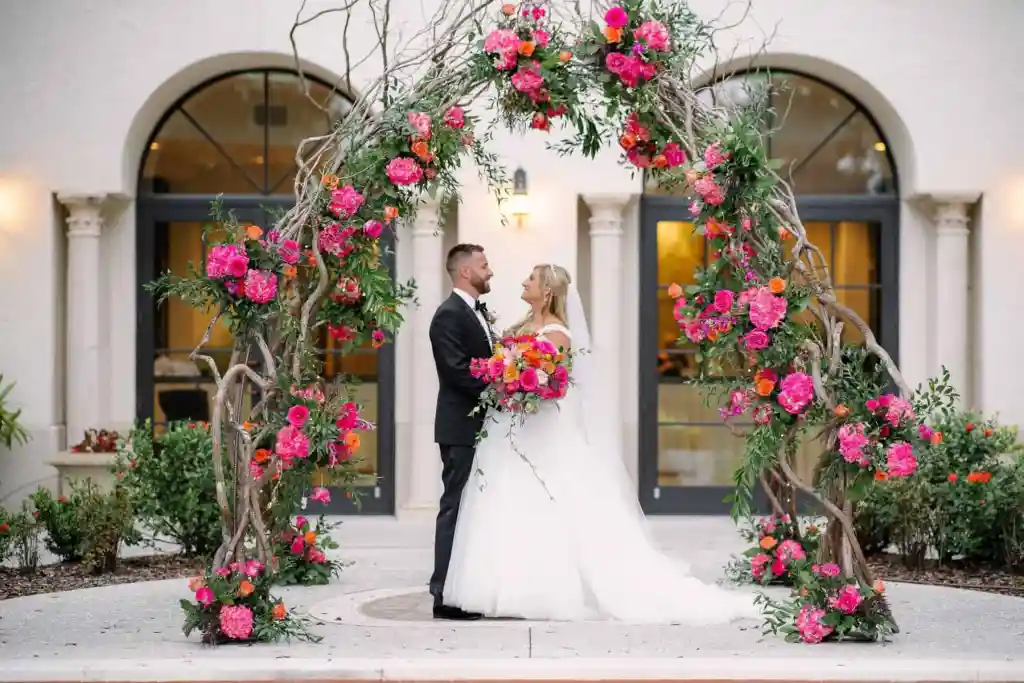
A standard “wedding ceremony outline“ typically runs 20–30 minutes. While you can customize every detail, most follow this proven structure:
-
Processional: Entrance of the wedding party.
-
Welcome: The officiant addresses the guests.
-
Readings/Rituals: Poems, songs, or symbolic acts (like a unity candle).
-
Vows & Ring Exchange: The legal and emotional heart of the ceremony.
-
Pronouncement: The “I now pronounce you…” moment.
-
Recessional: The couple exits to music.
Whether you’re planning a religious ceremony, a civil service, or something entirely non-denominational, this outline gives you a working template you can adapt to your style, beliefs, and practical logistics.
How Long Should a Wedding Ceremony Be?
| Ceremony Style | Typical Duration |
| Civil/courthouse ceremony | 5-15 minutes |
| Simple non-denominational ceremony | 15-25 minutes |
| Standard secular/modern ceremony | 20-30 minutes |
| Religious ceremony (Protestant) | 30-45 minutes |
| Catholic wedding Mass | 60-90 minutes |
| Jewish ceremony (full) | 30-60 minutes |
| Hindu wedding ceremony | 60-90 minutes or more |
The Standard Wedding Ceremony Order
Here is the core sequence used in most modern Western ceremonies, with notes on what happens at each point:
| Order | Element | Timing | Notes |
| 1 | Prelude music | 20-30 min before | Guests are seated; sets the tone |
| 2 | Processional | 3-5 minutes | Wedding party walks in; couple enters last |
| 3 | Welcome / Opening words | 2-3 minutes | Officiant greets guests, sets the tone |
| 4 | Opening reading or poem | 1-3 minutes | Optional; often by a family member or friend |
| 5 | Declaration of Intent | 1-2 minutes | ‘Do you take…’ – the legal moment |
| 6 | Second reading or ritual | 2-5 minutes | Optional sand ceremony, candle lighting, etc. |
| 7 | Vows | 3-5 minutes | Traditional, written, or mixed |
| 8 | Ring exchange | 1-2 minutes | Brief words from officiant + rings placed |
| 9 | Pronouncement | 30 seconds | You are now married |
| 10 | First kiss | 30 seconds | Keep it tasteful – photos are being taken |
| 11 | Introduction of couple | 30 seconds | Officiant presents the couple |
| 12 | Recessional | 2-3 minutes | Couple exits; wedding party follows |
Religious vs. Civil vs. Non-Denominational
| Type | Who Officiates | Legal Requirements | Key Differences |
| Civil | Registrar, judge, or licensed officiant | State/local marriage license | Minimal structure; purely legal |
| Non-denominational | Licensed friend, celebrant | Marriage license | Fully customizable; no religious content required |
| Protestant | Pastor or minister | Marriage license | Scripture, prayer, typically includes sermon |
| Catholic | Catholic priest | Pre-Cana required | Full Mass option; exchange of consent is required |
| Jewish | Rabbi | Ketubah (marriage contract) | Chuppah, breaking of the glass, Sheva Brachot |
| Hindu | Pandit (priest) | Varies by region | Saat Phere (7 rounds), Mangalsutra, multi-day events possible |
Readings: How to Choose and Where to Place Them
Readings work best when they feel chosen, not obligatory. Two readings maximum is the general guideline for ceremonies under 30 minutes – any more and the pacing drags.
- Place the first reading after the welcome, before the vows
- Place a second reading (if any) after the Declaration of Intent
- Choose readers who are comfortable speaking in front of a crowd – stage fright is contagious
- Mix formats: one poem + one prose reading keeps it interesting
Popular non-religious choices include excerpts from The Velveteen Rabbit, Captain Corelli’s Mandolin, Rumi’s love poems, or custom-written pieces. Avoid anything over 3 minutes – keep the focus on the couple.
Vow Options
Traditional vows (most common):
‘I take you to be my lawfully wedded partner, to have and to hold, from this day forward, for better for worse, for richer for poorer, in sickness and in health, to love and to cherish, till death do us part.’
Modern simplified vows:
‘I choose you. Today and every day. In joy and in difficulty. In laughter and in hard seasons. I am yours.’
Personal written vows – tips:
- Aim for 1-2 minutes (100-200 words) – longer gets emotional very fast
- Write to your partner, not to the audience
- Include one specific memory – it makes it feel real, not generic
- Practice out loud at least five times before the day
Music Cues: What Plays When
| Moment | Music Type | Examples |
| Prelude (guests seated) | Soft, ambient | Acoustic guitar, string quartet, classical piano |
| Processional (wedding party) | Moderate, joyful | Canon in D, A Thousand Years, contemporary covers |
| Bride/couple enters | Dramatic, meaningful | Custom choice – personal song or classic |
| Signing of register | Soft background | Instrumental version of meaningful song |
| Recessional |
Tips for Personalizing Without Losing Structure
- Add rituals that mean something – unity candle, sand ceremony, hand-fasting – but keep it to one
- Brief is better: every element should earn its place in the timeline
- Give your officiant a full written script at least 2 weeks before
- Have a backup plan for outdoor ceremonies – weather, microphone, lighting
- Time a full rehearsal – most couples are surprised how fast (or slow) the real thing goes
- Let the structure carry you; the emotion will follow on its own